
Key Takeaway
- An employee testimonial video is a short film in which your own crew, not your marketing team, describes what it is actually like to work for you.
- Canada had 40,100 unfilled construction jobs in December 2025, a 3.3% vacancy rate (Statistics Canada).
- Alberta construction needs 59,000 workers by 2034, with 43,400 retirements coming — a net gap of about 15,400 (BuildForce Canada, 2025).
- Apprentices are the most mobile people in your workforce. In one provincial survey, 45% of construction respondents had changed employers in the past year, and the top reason was pay (BC Construction Association, 2023).
- Film on the site, not in a boardroom. The site is the job.
- Quality still counts: 89% of consumers say video quality affects how much they trust a brand (Wyzowl, 2026).
What is an employee testimonial video?
An employee testimonial video is a short video in which a current employee talks, in their own words, about working at your company. No script read to camera. No HR language. A journeyman explaining why he came over from a competitor and stayed six years.
It is not a recruitment ad. A recruitment ad makes a promise. An employee testimonial video lets somebody else make the promise for you, which is the only version a skeptical apprentice will believe.
Most articles on this topic show you Google, Slack and Salesforce. Useful if you run a software company. Less useful if you are trying to staff a concrete crew in February.
Why trades employers need these more than tech companies do
The numbers are not subtle.
Statistics Canada put construction job vacancies at 40,100 in December 2025 — a vacancy rate of 3.3% against payroll employment of 1,183,300. By May 2026, construction vacancies were rising again: up 5,900 month over month, an 18.4% jump, making it one of only four sectors where vacancies grew that month.
Look further out and it gets harder. BuildForce Canada projects Alberta’s construction industry will need to recruit 59,000 workers between 2024 and 2034. Roughly 43,400 workers — about 21% of the 2024 workforce — are expected to retire in that window. Even with 43,600 new entrants arriving, the province faces a net shortfall of about 15,400 people.
The supply side is not idle. Canada registered a record 101,541 new apprentices in 2024, up 5.9%, with construction-related trades among the fastest growing — interior finishers up 27.9% and construction workers up 24.2%. Alberta alone had 64,756 registered apprentices as of July 2024, with 25,400 new registrations in the 2023-24 year, a 25% jump.
But look at what happens to them. Statistics Canada’s 2024 pathway indicators put the national apprentice certification rate at 19.9%, the continuation rate at 49.2%, and the discontinuation rate at 30.9%. Nearly a third of registered apprentices leave.
And the ones who stay move around. The BC Construction Association’s 2023 industry survey of more than 1,300 respondents found roughly 45% had changed employers within the past year, with the number one reason being higher pay. Their 2024 survey narrowed it further: apprentices specifically are the group most likely to change employers for higher pay.
That is your recruiting environment. A large, growing pool of new entrants, a third of whom will drop out, and the rest of whom will move for money unless something else holds them.
A written job posting cannot compete with that. A video of someone who is already doing the job, on the job, is the closest thing to a referral that you can publish at scale.
What a good one actually looks like
Forget the format you have seen from tech brands — the bright office, the ping pong table, the soft piano. Yours has a different vocabulary.
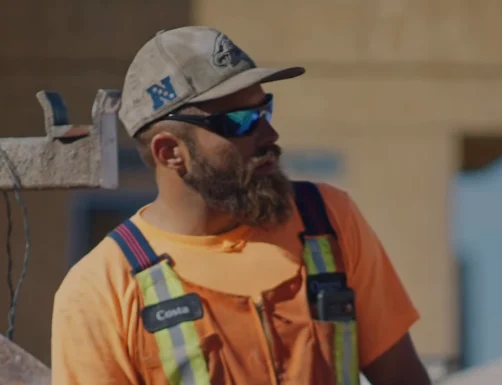
Film where the work happens. A superintendent talking on a live site, with the crane moving behind him, carries information no boardroom interview does. The viewer learns the scale of your projects without you claiming anything.
Use one person per video. Cutting six people into a two-minute montage produces a company statement, not a testimonial. One person, one story, ninety seconds.
Let them be specific. “Good company culture” is worthless. “My foreman drove out to Airdrie on a Saturday to help me get my truck started” is worth the whole shoot.
Show the trade. Hands, tools, the pour, the weld, the finish. Your audience is people who do this work. They will read the craft in the b-roll before they hear a word of the interview.
Pick the right person, not the most senior one. The most persuasive speaker for an apprentice audience is someone two years ahead of them, not a twenty-year veteran. Cast for the viewer you want, not for the org chart.
If you want a broader look at how this fits with hiring content generally, we cover the full picture in our guide to recruitment videos for construction.
Which employee should you film?
| Who | What they are good for | Watch out for |
|---|---|---|
| Second-year apprentice | Recruiting apprentices — closest to the viewer’s own position | May be nervous; needs the most warm-up time |
| Journeyperson, 5–10 years in | The “I stayed and here’s why” story; retention message | Can drift into complaints if the interview is unstructured |
| Foreman or superintendent | Credibility, scale, how the company runs a job | Defaults to management language; push for specifics |
| Office or estimating staff | Shows there is a path off the tools | Weakest for field recruiting; use as a secondary video |
| Recent hire from a competitor | The comparison story, which is the most persuasive of all | Never let them name the previous employer on camera |
Questions that get real answers
The interview is where these videos are won or lost. Bad questions produce brochure language. These do not:
- What were you doing before you came here?
- What did you think this place would be like, and what was it actually like?
- Walk me through a day that went badly. What happened?
- Who taught you something here?
- What would you tell your younger self about getting into this trade?
- What is the part of this job people outside it never see?
- What is the hardest thing about working here?
- Would you send your kid into this trade? Why?
Question three is the one that matters. A crew member describing a day that went sideways — and how the company handled it — builds more trust than any number of people saying they love it here. Question seven is the one most employers cut. Leave it in. An answer like “the winter starts are brutal, but they pay for the gear and nobody gets left standing around” is worth more than a page of copy.
Do not send the questions in advance. Send the topics. People who rehearse answers deliver rehearsed answers.
Getting a non-actor comfortable on camera
Most of your crew have never been filmed. Some will say no, and that is fine — never make it a condition of anything, and never let a supervisor be the one who asks.
For the ones who say yes:
- Roll early and keep rolling. The usable take is almost never the first one. It is usually the moment they think you have stopped.
- Talk to a person, not a lens. They look at the interviewer. The camera is off to the side. It stops the deer-in-headlights problem immediately.
- Do not correct their grammar. Their voice is the asset. Polishing it out is how you end up with a corporate video nobody believes.
- Give them an out. Tell them upfront they can review the cut before it goes out. Most never ask. Knowing they can is what relaxes them.
- Film them working first. Twenty minutes of b-roll before the interview does more to settle someone than any amount of reassurance. By the time they sit down, the camera is furniture.
We go deeper on this in contractors on camera: tips for people who hate being filmed.
Filming on an active site without becoming a hazard
This is the part no generic guide covers, because most people writing about testimonial video have never been on a live site. In Alberta it is also a legal question, not just a courtesy one.
Alberta’s Occupational Health and Safety Act, section 3(1)(a), puts the employer’s duty not only over its own workers but over “those workers not engaged in the work of that employer but present at the work site” and “other persons at or in the vicinity of the work site whose health and safety may be materially affected.” A film crew is squarely inside that wording.
Section 10(1) adds that every construction work site with two or more employers involved must have a prime contractor — and that prime contractor is responsible for ensuring no person is exposed to hazards arising from activities at the site. On a client’s project, the prime contractor decides whether your camera comes through the gate.
Two more provisions shape the day. OHS Code section 7 requires the employer to assess a work site and identify hazards before work begins and to prepare a written report of the results. Section 228 requires that where the hazard assessment indicates PPE is needed, workers wear equipment correct for the hazard and are trained in its use.
Translated into a shoot day:
- Clear access through the prime contractor, in writing, before you book anything.
- Full PPE for the camera crew, not just the people on camera. Anything visible in frame that breaches site standards becomes an internal problem for your client the day it publishes.
- Site orientation and safety briefing before call time. Build the hour into the schedule.
- Book around the work, not against it. Pours, inspections and crane picks do not move for a video shoot. Interviews go in the gaps — early morning, lunch, end of shift.
- Audio is the hard part. Generators, compressors, traffic, wind. A lav mic under a hi-vis vest and a windscreen are the difference between usable and unusable. Walk the site beforehand and pick a quieter interview position; do not discover it on the day.
- Watch the background. Competitor signage, unsafe practice, an unreleased design — all of it ends up on the internet permanently.
A worked scenario
A mechanical contractor with 120 field staff is losing second-year apprentices to a competitor across town paying a dollar more an hour. Their careers page has a paragraph about “a culture of excellence” and a generic stock photo.
What actually works: two videos, filmed on one day, on one active site.
The first is 75 seconds with a third-year apprentice who came from that same competitor. He talks about being handed a task he was not ready for, being backed up rather than blamed, and getting his hours signed off on time. He never names the other company. The second is 90 seconds with the foreman who trained him, describing what he looks for in an apprentice and what he owes them.
Deliverables from that one day: two long cuts for the careers page, four vertical cuts for Instagram and job postings, a set of stills, and a paragraph of pull quotes for the job ad. Total field time, about five hours including safety orientation.
The dollar an hour still exists. But the apprentice comparing two employers now has something on one side of the ledger that the other side does not have at all.
Releases and permissions
Get a signed appearance release from every person who speaks on camera, and check your background for anyone who has not signed. A workable release covers name, likeness, voice and job title; the platforms where the video may appear; whether anything is being paid; and how long the permission runs.
Two habits worth building in. First, an employment relationship makes consent complicated — nobody should feel that appearing is expected of them, so keep the ask separate from any supervisor and make declining consequence-free. Second, decide in advance what happens when the person leaves. Our rule: no former employee stays on a careers page. Put the review date in the calendar the day you publish.
Have your own lawyer set the template once. This article is not legal advice.
Where the video goes after the shoot
Filming it is half the job. Most employee testimonial videos die on a careers page nobody visits.
| Placement | Cut | Note |
|---|---|---|
| Careers page | 90–150 sec | Above the fold, with the transcript as page text |
| Job postings | 60–90 sec | Every trade posting, embedded or linked |
| LinkedIn and Instagram | 30–45 sec vertical | Captioned; strongest line in the first three seconds |
| Onboarding pack | Full cut | New hires meet the crew before day one — see employee onboarding videos |
| Trade shows and job fairs | Silent loop | Burned-in captions, no audio needed |
| Apprenticeship and school outreach | 90 sec | The audience deciding whether to enter the trade at all |
One more thing. Refilm every two years, or when the person leaves. A testimonial from someone who no longer works for you is worse than no testimonial at all.
If you want these shot properly on a live site, without slowing the job down, that is the work we do.
Pre-shoot checklist
- ☐ Site access cleared in writing with the prime contractor
- ☐ Safety orientation booked for the crew, before call time
- ☐ PPE confirmed for everyone attending, camera crew included
- ☐ Shoot scheduled around pours, lifts and inspections
- ☐ Quiet interview position identified during a site walk
- ☐ Appearance releases printed and signed before rolling
- ☐ Background checked for competitor signage, unreleased design, unsafe practice
- ☐ Subject briefed on topics, not questions
- ☐ Twenty minutes of working b-roll planned before the sit-down
- ☐ Deliverable list agreed: long cut, social cuts, stills, pull quotes
- ☐ Review date set for two years out
FAQ
What is an employee testimonial video? A short video in which a current employee describes, in their own words, what it is like to work at your company. It differs from a recruitment ad because the promise comes from the employee rather than the employer.
How long should an employee testimonial video be? Sixty to ninety seconds for social and job postings. Ninety seconds to two and a half minutes for a careers page, where the viewer has already chosen to learn more. Anything past three minutes is a documentary, not a testimonial.
Should we pay employees to appear? You do not need to, and paying introduces a disclosure question. Film on the clock, feed the crew, and credit them properly. That is the fair version.
What if the employee quits after we publish it? Take it down. Keep a simple rule: no former employee stays on the careers page. Build the refresh into your annual marketing calendar.
Do we need a signed release? Yes. An appearance release covering name, likeness, voice, job title and the platforms you will publish on. Have your own lawyer review the wording once, then reuse it.
Can we film these ourselves on a phone? You can, and for social it sometimes works. The risk is that 89% of consumers say video quality affects their trust in a brand (Wyzowl, 2026) — and a recruit deciding between two employers is making a trust judgment.
Do we need permission to film on a client’s job site? Yes. Under Alberta’s OHS Act, a construction site with two or more employers must have a prime contractor responsible for hazards at the site. Clear your access with them in writing before booking a crew.
Does the film crew need PPE? Treat it as yes on any active site. Alberta’s OHS Act extends the employer’s duty to other persons at or in the vicinity of the work site, and any non-compliance visible in your footage becomes a problem the day it publishes.
Which employee makes the best subject? For recruiting apprentices, someone one or two years ahead of the viewer. Proximity beats seniority — a second-year apprentice is more persuasive to a first-year than a twenty-year veteran is.
How many videos do we need? Two or three, refreshed on a cycle, beats one perfect film. Different trades and different career stages need different faces, and a single video ages out the moment that person leaves.
Turn Your Crew Into Your Best Recruiting Tool
Your next great apprentice is already looking for a company that feels like the right place to build a career. Give them something more convincing than a job description.
Storimatic creates employee testimonial videos for Calgary and Western Canadian construction companies—filmed on real jobsites, with real employees, telling real stories.
We handle the interview, filming, site logistics, and editing so your crew can focus on the work while your future hires see what working for your company actually looks like.
Ready to show the people behind your projects? Book a strategy call with Storimatic and let’s identify the employees, stories, and jobsites worth putting on camera.
Sources
- Statistics Canada, “Job vacancies and job vacancy rate — seasonally adjusted,” December 2025 data, released February 26, 2026
- Statistics Canada, “Payroll employment, earnings and hours, and job vacancies, May 2026,” released July 30, 2026
- Statistics Canada, “New registrations, certifications and pathway indicators of registered apprentices in Canada, 2024,” December 11, 2025
- BuildForce Canada, “Employment demands increase in Alberta to 2034,” April 3, 2025
- Government of Alberta, Apprenticeship and Industry Training, “Registrar’s Report 2023-24”
- BC Construction Association, “Annual Survey Reveals a Construction Industry Under Strain,” April 17, 2023
- Government of Alberta, Occupational Health and Safety Act, ss. 3, 10
- Government of Alberta, Occupational Health and Safety Code, Part 2 s.7 and Part 18 s.228
- Wyzowl, “Video Marketing Statistics 2026”