By Jared Ho, founder of Storimatic Studio (Calgary). Embedded video and content contractor for the Omega Group since 2022. Published June 21, 2026.
To choose a video production company, stop ranking them by reel and price. Vet them on three trust signals instead: whether they’re a good hang, whether their claims survive a fact-check, and whether the scope on the quote is sane. The slickest reel can be one lucky job (or borrowed footage), and the lowest quote almost always means somebody is doing three jobs at once and will burn out before your edit is done. The reel lies. The cheap quote is the trap. The signals below are what actually predict whether you’ll be happy in six months.
If you’re still building your shortlist, our guide to choosing the best video production agency explains the evaluation framework in more depth before you start requesting proposals.
How do you choose a video production company?
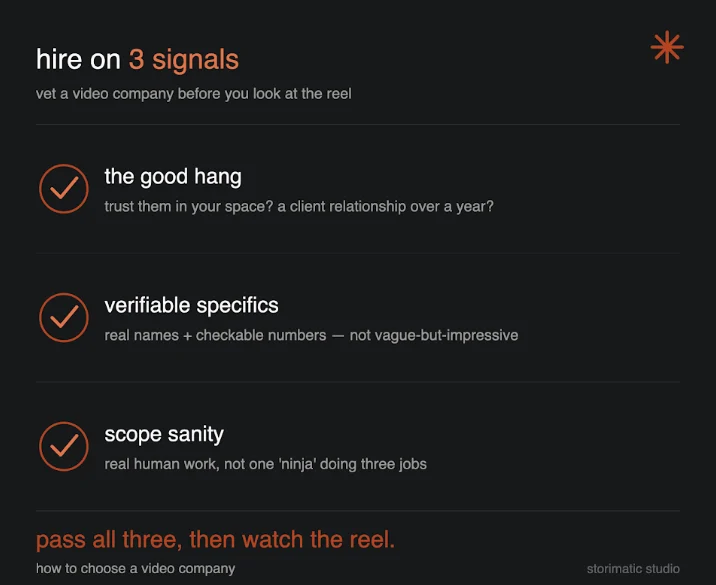
Don’t hire the best reel or the lowest quote. Hire on three checkable trust signals. (1) The good hang: can you stand spending two days on a jobsite with these people, because the smoothest project is run by people you trust, not the most awarded. (2) Verifiable specifics: every claim they make should be checkable (real client name, real numbers, a process they can explain), because vague-but-impressive is the tell of AI slop and stretched truth. (3) Scope sanity: the quote should describe a real amount of human work, because a “videography ninja” priced at one body for three jobs is a flight risk. Score every shortlisted vendor on those three. Then look at the reel.
Why doesn’t the best reel win?
The best reel doesn’t win because a reel is a highlight tape, not a track record. It shows you the three best minutes from the three best jobs of someone’s entire career, with no way to tell whether that was their crew, their client’s budget, or one good day. You’re not buying the reel. You’re buying the next project, with your timeline, your stakeholder who hates being on camera, and your jobsite in February.
This is the single most important reframe in the whole hiring decision, and it comes straight from someone who hires video people for a living. In a thread that earned 684 upvotes on r/videography titled “I hire videographers a lot, best advice I can give,” the buyer wrote:
“There is only one commonality between them… They were all people I respected, trusted, and ENJOYED SPENDING TIME WITH. There are even examples where outright I would hire a LESS skilled videographer at a competitive day rate.” — r/videography, ↑684
Read that twice. A frequent buyer of video — the exact person whose seat you’re in — says the deciding factor wasn’t talent. It was trust and whether he wanted to be around them. He would knowingly hire the less skilled person.
That isn’t anti-craft. It’s how video actually gets made. A corporate or construction shoot is one to three days of strangers in your space, asking your foreman to repeat himself, telling your CEO where to stand, troubleshooting when the light dies at 4 p.m. and the concrete pour can’t wait. The reel can’t tell you how someone behaves in that room. The “good hang” can. So the question isn’t who’s the most talented. It’s who do I trust in my space when something goes wrong? And that opens the obvious follow-up: if talent isn’t the filter, what is?
What is the “good hang,” and how do you actually test for it?
The “good hang” is a vendor’s ability to be trusted, easy, and competent in your space under pressure, and you test for it by watching how they behave before you’ve paid them a cent. It is not charisma and it is not a nice sales call. It’s whether they ask sharp questions about your business instead of talking about their gear, whether they push back honestly when your idea won’t work, and whether they treat the small pre-project moments (a clear email, an on-time call, a straight answer about timeline) like they matter. Those moments are the trailer for the whole project.
Here’s where most buyers go wrong: they treat the discovery call as a sales pitch to be endured, when it’s actually the single best behavioral test you’ll get. The vendor who, unprompted, asks “who’s the one decision-maker who has to love this, and what would make them cringe?” has just shown you more than any reel could. The vendor who only wants to talk about their camera body has shown you something too.
This is also where Storimatic’s own credential lives, and it’s worth being precise about it because precision is the whole point of this article. Storimatic has been the embedded video and content contractor for the Omega Group (Omega Ready Mix, Omega 2000 Cribbing, and Omega Precast, owned by Bryan Regular) since 2022.
That’s three-plus years inside one operator’s world: same jobsites, same crews, same February pours, same stakeholders. That relationship is not an award. It’s the ultimate “good hang” proof, because no one keeps an outside contractor embedded for three years unless the hang is good and the work holds up. A reel can be faked in a weekend. A three-year working relationship cannot.
And it isn’t a single relationship — it’s a pattern, which is the part that actually protects you. A commercial concrete contractor we documented was watched so closely that the general contractor on the job hired us as their own video partner. A Calgary nonprofit liked the first film enough to bring us back a second year. Referrals from inside a client’s own network, and clients who re-hire, are the exact signal a one-weekend reel can’t manufacture.
So you can test the hang directly. Ask a vendor for a client they’ve worked with for more than a year and ask to talk to that client. One great-looking one-off job is a coin flip. A multi-year relationship is a pattern — and patterns are what you’re actually buying.
Which raises the next trap, because the moment you start asking for proof, you’ll get handed a lot of impressive-sounding claims. How do you tell the real ones from the manufactured ones?
How do you tell a real review or claim from AI slop?
You tell a real claim from a fake one with a single test: specificity that survives a fact-check. A real review or case study names names, cites a number you could verify, and describes a process only an insider would know. AI slop and stretched marketing copy do the opposite. They’re fluent, confident, and weirdly generic, full of “boosted engagement” and “elevated the brand” with nothing a stranger could check. The Storimatic rule we hold our own content to is blunt: if a sentence could have been written about any vendor, it isn’t proof. It’s décor. Specificity is the trust currency. Rewrite (or distrust) anything that fails it.
People are getting very good at spotting the fake version, and you should borrow their instinct. In an r/rust thread that hit 566 upvotes, a commenter dismantled a too-good-to-be-true success story in one line:
“Someone posted an AI generated Reddit post… It’s obviously a fake.” — r/rust, ↑566
That reflex — this is obviously fake — is exactly what you want at the top of your vendor-vetting funnel. The “obviously fake” tell is almost always an absence of checkable detail dressed up as a confident result.
The skeptic’s version of the same instinct shows up when a vendor claims a business outcome. On an r/Entrepreneur thread (↑99) about a “$18k/mo to $260k/mo” (USD) backpack story, the top objection cut straight to credibility:
“OP runs a ad shop and is not the store owner, how TF would he know net profit” — r/Entrepreneur, ↑99
This is the most important objection a video buyer can internalize. When a production company tells you a video “drove $X in revenue” or “tripled their leads,” ask the r/Entrepreneur question: how would they even know that? The agency made the video. They don’t have the client’s CRM, their close rate, or their margins. A revenue claim from a vendor who never saw the books is, at best, a number the client mentioned once. At worst, it’s fiction.
So what does a checkable claim look like? Here’s the only client metric Storimatic will put in writing, stated exactly as narrow as it actually is: a campaign on Bryan Regular’s personal LinkedIn earned 27,000 impressions and reached 15,000 people in seven days. Notice what that claim does and doesn’t do. It names the platform (LinkedIn), the account (a real, named person’s personal profile), the metric (impressions and reach, both numbers the platform itself reports), and the window (7 days).
It does not claim revenue, leads, or closed deals, because those live in the client’s business, not ours. Per the r/Entrepreneur rule, we’d have no honest way to know them. That’s the shape of a claim you can trust: bounded, attributed, and made of numbers the claimant could actually see. When you’re evaluating a vendor’s results, hold every number they give you to that standard. The good ones will pass. The slop won’t.
Now for the other trap — the one hiding in the quote itself.
What are the red flags in a video production quote?
The biggest red flag in a video production quote is a scope that doesn’t add up to a real amount of human work: most often a single person priced to do the jobs of three or four. Video is shot, directed, lit, recorded, and edited; those are distinct crafts, and a quote that quietly assumes one underpaid body will nail all of them is not a deal, it’s a countdown to a missed deadline or a half-finished edit. The trades have a name for the equivalent hire, and it’s a perfect tell.
On r/Filmmakers (↑178), a post about job listings nailed the pattern:
“Looking for videography ‘guru’, ‘ninja’, or ‘rockstar.’ translation: Looking for someone to do 3 jobs for less than the pay of one.” — r/Filmmakers, ↑178
That’s written from the hiring side, but it works perfectly as a buyer’s filter. When a quote is suspiciously cheap, run the “videography ninja” test: ask the vendor to break the project into its actual roles and hours. Who’s directing, who’s running camera, who’s doing audio, who’s editing, and how many hours does each take? A confident, honest vendor answers in specifics. A flight risk gets vague, because the cheap number only exists if one person silently absorbs all of it.
To calibrate what “a real amount of work” even means, listen to an actual production-company owner describe his own cost structure. On r/editors (↑47), an owner laid it out:
“I currently work with 3 editors at $50 per hour and our average project is 10-12 hours.” — r/editors, ↑47
Sit with that: editing alone (not shooting, not directing, not the gear, not the producer’s time) is 10 to 12 hours per project at a real hourly rate, and he runs three editors to keep up. So when a quote for a full shoot-plus-edit comes in at a price that wouldn’t even cover that editing line, you’ve found your red flag. The number isn’t a bargain. It’s a tell that something in the scope is fictional, and you’ll discover which thing was fictional at the worst possible moment.
This is where Storimatic’s Cost Curve does the explaining. The Cost Curve is our way of mapping price to the invisible craft (the hours of pre-production thinking, the relationship time, the editing passes, the revisions) that a buyer can’t see in the final two-minute video but absolutely paid for (or didn’t). A quote that’s cheap because it’s efficient sits in a healthy spot on the curve.
A quote that’s cheap because it deleted the invisible work sits in the danger zone: you save money today and pay it back in a video that dies in a folder. The point of the curve isn’t “expensive is good.” It’s “the price has to map to real work, and you should be able to see where every dollar went.” Which leads to the structural question underneath the quote: are you better off with an agency or a freelancer at all?
Agency or freelancer — which should you hire?
Hire a freelancer when the job is small, well-defined, and low-stakes; hire an agency or a small studio when the project is multi-stakeholder, ongoing, or the kind of thing that has to not fall apart when someone gets sick. The honest trade-off is this: a great freelancer often gives you more talent per dollar, but a single point of failure; an agency costs more but spreads risk across a team and a process. The deciding question is the one nobody asks in the sales call. What happens the day something goes wrong? If the answer for the freelancer is “the project stops,” and the stakes are high, that’s your answer.
Notice that this maps back to the “good hang.” A freelancer is the hang: there’s no team to hide behind, which is great when they’re great and catastrophic when they’re not. A studio’s hang is distributed, which is why the multi-year track record matters even more: it tells you the system is a good hang, not just one charismatic person. We go deep on this trade-off, including how to de-risk a freelancer hire and when a small embedded studio beats both, in the dedicated breakdown linked at the bottom.
Either way, the three signals don’t change. A freelancer still has to pass the good-hang test, the specificity test, and the scope-sanity test. The structure changes who absorbs the risk; it doesn’t change what you’re vetting for.
How much should you actually pay for a corporate video?
You should pay enough to cover the real, invisible work, and the honest answer is that there’s no single number, because the price tracks the scope, not the runtime. A talking-head testimonial shot in an afternoon and a multi-day brand film with a crew are both “a corporate video,” and pricing them the same is how buyers get burned in both directions. The useful move isn’t hunting for the number; it’s pressure-testing the scope-to-price ratio using the r/editors reality check above. If the quote can’t even cover the editing hours, the rest of the scope is fiction.
We dig into the actual ranges, what drives them, and why no reputable studio will print a flat price without scoping your project in the dedicated pricing guide below. The short version for this hub: cheap-because-efficient is fine; cheap-because-the-work-was-deleted is the trap the whole Cost Curve exists to expose.
Can you trust the client results a video company claims?
Trust a claimed result only if it’s bounded, attributed, and built from numbers the claimant could actually see, and distrust any result that quietly credits a video for the client’s revenue, leads, or sales. Re-read the r/Entrepreneur objection: how would they even know that? The video company didn’t have the client’s books. So a clean, trustworthy claim looks like the Omega example above (a named person’s LinkedIn, platform-reported impressions and reach, a stated 7-day window), and a shaky one looks like “we drove six figures in pipeline,” asserted by people who never saw the pipeline. The full method for stress-testing a vendor’s case studies is in the verification deep-dive linked below.
The buyer’s checklist (steal this)
Run every shortlisted vendor through these three gates, in this order, before you let the reel sway you:
- The good hang. Did they ask sharp questions about your business? Do they have a client relationship longer than a year you can call? Would you want them on your jobsite for two days? (Reddit’s hard-won lesson: the best buyers hire trust over talent — ↑684.)
- Verifiable specifics. Does every claim name names and cite checkable numbers? Or is it fluent, confident, and generic — the “obviously fake” smell? If a line could be said about any vendor, it isn’t proof.
- Scope sanity. Break the quote into roles and hours. Does it describe real human work, or one “ninja” doing three jobs? Does the price even cover the editing reality (10–12 hours, per an actual owner)?
Pass all three, then watch the reel. Now the reel is confirmation, not the decision.
One honest CTA
If you’re a Western Canada business (construction, corporate, or otherwise) about to commission video and you want a vendor who’ll pass its own three gates, that’s the bar Storimatic holds itself to: a multi-year embedded track record (three-plus years inside the Omega Group), claims we keep narrow enough to verify, and quotes that map to the real work on the Cost Curve. If that’s the kind of partner you’re vetting for, reach out for a straight conversation. We’ll ask the sharp questions first, and you can judge the hang for yourself.
FAQ
How do I choose a video production company? Vet on three trust signals before you look at the reel: the good hang (can you trust them in your space, and do they have a client relationship longer than a year), verifiable specifics (every claim names names and cites checkable numbers), and scope sanity (the quote describes real human work, not one person doing three jobs). The best reel and the lowest quote are both traps.
Why shouldn’t I just hire the company with the best reel? Because a reel is a highlight tape: the best minutes of the best jobs, with no way to tell if that was their crew, their client’s budget, or one lucky day. A buyer on r/videography who hires videographers often said the only commonality among his best hires was trust and being a good hang, not talent; he’d even hire the less skilled person. You’re buying your next project, not their best past one.
What are the red flags in a video production quote? The biggest one is a scope that doesn’t add up to real work — usually a single underpaid person priced to shoot, direct, light, record, and edit. r/Filmmakers calls it the “ninja/guru/rockstar” listing: three jobs for less than the pay of one. Break any suspiciously cheap quote into roles and hours; if it can’t even cover the editing time (an actual owner cited 10–12 hours per project), something in the scope is fiction.
Can I trust the results a video company claims? Only if the result is bounded, attributed, and made of numbers the claimant could actually see. Be skeptical of revenue or lead claims — the agency made the video, not the client’s sales; as one r/Entrepreneur commenter put it, “how TF would he know net profit.” A trustworthy claim looks like a named account, a platform-reported metric, and a stated time window (for example, 27,000 LinkedIn impressions / 15,000 reached in 7 days on a named person’s profile).
Should I hire an agency or a freelancer for video? Hire a freelancer for small, well-defined, low-stakes jobs where more talent per dollar matters; hire an agency or small studio for multi-stakeholder, ongoing, or high-stakes work where the project must survive someone getting sick. The deciding question is what happens the day something goes wrong — a freelancer is a single point of failure, a studio spreads the risk. Either way, both still have to pass the good-hang, specificity, and scope-sanity tests.

Written by
Jared Ho
Founder of Storimatic Studio in Calgary. Video production specialist for businesses, with a focus on the construction industry, delivering 750+ projects and 20M+ views for clients. Services include construction video production, corporate video, training video, brand storytelling, and aerial drone footage. Drone-licensed and on-site at every shoot.
Ready to turn this into a video that wins business?
View Storimatic Video Services →