A contractor with a website and a Google profile and nothing else doesn’t read as “small.” It reads as thin. To the procurement officer reviewing your bid, and now to the machine your buyer asks first.
Bid loss is a proof problem, not a price problem — experienced contractors win ~12% more when they differentiate on qualifications.
There is a word procurement officers use, quietly, when a bidder has a clean price but nothing behind it: thin. No track record they can see. No proof of the crew. No evidence the company is real beyond a logo and a phone number. A thin bidder gets a polite “thanks” and a place at the bottom of the shortlist.
In 2026, the AI your buyer asks before they ever open your bid uses the same logic — and now it’s measurable:
- A contractor present only on a website and a Google Business Profile gives the AI “not enough data points to trust them.” AI builds answers from review sites, directories, forums, video, and local media, then surfaces companies with multi-source consensus (Geek Powered Studios, 2026).
- AI weighs what others say about you ~3x higher than what you say about yourself (Search Engine Land, 2026). Your homepage is the least trusted source about you.
- The 2026 trust crisis demands “real video, real people, real locations.” As synthetic content floods the web, buyers and engines reward verifiable proof (National Law Review, 2026).
- Bid loss is a proof problem, not a price problem. Experienced contractors win ~12% more work when they differentiate on demonstrated qualifications rather than price. Video is the missing case file in the procurement room.
- 94% of B2B buyers now use ChatGPT, Perplexity, or Gemini to build their shortlist before contacting a company (G2 / Forrester, 2026). The shell-company filter runs before your bid is ever read.
The thesis in one line: Silence is no longer neutral. A contractor with no jobsite footage, no owner on camera, and no project films reads as a shell company — to the procurement officer and to the AI — and both screen you out before the conversation starts.
This post is for the construction owner who has lost a bid he should have won, suspects the problem wasn’t his number, and has never connected that loss to the empty space where his proof should be. It’s the same empty space the machine now sees.
1. Name the Problem: Your Bid Didn’t Lose on Price. It Lost on Proof.
Rule #44, Name-the-Problem, holds that the one who names the problem owns the answer. So let me name the problem most contractors are getting wrong, because naming it correctly is the entire fix.
You think you lose bids on price. You usually don’t.
Storimatic’s construction research is unambiguous on this, and it’s the most important sentence a contractor can internalize: bid loss is a proof problem, not a price problem. Experienced contractors win roughly 12% more work when they differentiate on demonstrated qualifications — track record, crew quality, safety culture, proof they can actually do the job — rather than racing to the bottom on number. The owner who frames every loss as “we got underbid” is solving the wrong problem. He shaves his margin, bids lower next time, and loses again — because the buyer was never choosing on price alone. The buyer was choosing on certainty, and couldn’t find enough of yours.
Here is what that looks like in the room. A developer’s project manager has three bids on the desk. Yours is competitive. But when the PM goes looking for proof — who are these people, have they done this before, what does their work actually look like, can I defend this choice to my boss — yours is the bid with the least to find. A logo. A phone number. A line that says “20 years of quality service.” The other two have project case studies, a recognizable owner, evidence of the crew on real sites. They are not better contractors. They are better-proven contractors. And in a decision about risk, better-proven wins.
This is a Problem-Aware post in Schwartz’s sense: you feel the pain of lost bids, but you may be misnaming its cause. The cause is a proof gap. And in 2026, that exact same proof gap now gets you screened out one step earlier — by the machine, before your bid is ever read.
2. The Shell-Company Signal: What “Thin” Looks Like to a Machine
The proof gap used to cost you only in the bid room, where a human read it. Now it costs you upstream, in the AI your buyer consults first. And the machine’s version of “thin” has a precise, documented mechanism.
From Geek Powered Studios’ 2026 guide to AI visibility for contractors — read this slowly, because it reframes your entire online presence:
“If a contractor’s presence exists only on their website and Google Business Profile, they don’t have enough data points for the AI to trust them. AI synthesizes answers from review sites, directory listings, forum mentions, and recent blog content, then surfaces businesses with multi-source consensus.” — Geek Powered Studios, 2026
A website and a Google Business Profile feels like “having an online presence.” To a human, it reads as a baseline. To an AI deciding whether to recommend you, it reads as insufficient evidence to form a judgment — which functionally means don’t recommend. The engine has one source (your site, which it discounts heavily) and a directory listing. That is not enough to assemble a confident answer, so when a buyer asks “who are the best mechanical contractors in Calgary,” the machine names the companies it can corroborate — and skips the one it can’t.
This is the digital twin of the procurement officer’s “thin.” The PM couldn’t find enough proof, so he ranked you last. The AI can’t find enough data points, so it leaves you out. Same judgment, same cause, two steps in the same buying journey — and the AI step now happens first, because 94% of B2B buyers use a generative AI tool to build their shortlist before contacting a single company (G2 / Forrester, 2026). If you fail the machine’s shell-company filter, the human never even gets your bid.
The hard part for most owners to accept: this is not a neutral absence. It is a negative signal. Having no jobsite footage, no owner on camera, no project films, no testimonial video doesn’t leave you at zero. It actively starves the engine of the multi-source data it needs to trust you — which reads, against competitors who have that data, as a reason to pass.
3. Multi-Source Consensus: Why One Website Was Never Going to Be Enough
The phrase doing the work in that Geek Powered finding is multi-source consensus. It is the core of how generative AI decides who is real, and it explains why no amount of polishing your own website will fix the problem.
An AI engine does not trust a single source — least of all the source you control. It assembles a recommendation by cross-referencing what multiple independent surfaces say about you and looking for agreement. Does the review site say you do quality work? Does the directory confirm you’re a real, located business? Does a forum mention you favorably? Is there video of your actual crew on actual sites? Does local media reference your projects? When several independent surfaces converge on the same picture of you, the machine has consensus — and it recommends you with confidence. When only your own website speaks, there is no consensus to find. There is just you, talking about yourself, which the engine has learned to discount.
That last point has a number on it, and it’s the one that should retire the “we just need a better website” instinct for good:
AI weighs third-party mentions about a brand roughly 3x higher than the brand’s own website. — Samanyou Garg, via Search Engine Land, 2026
Your homepage is the single least trusted source the machine has about you. You can spend a fortune making it beautiful and it still counts for a fraction of what one customer’s testimonial on YouTube, or one project film, or one forum thread counts for. Consensus is the algorithm. The job is not to perfect the one source you own. The job is to manufacture the other sources — the third-party, independent, corroborating ones — so the machine has something to reach consensus with.
And here is the connection a contractor needs to make: video is the densest, most efficient way to manufacture those sources. A jobsite walkthrough on YouTube is a third-party-platform surface. A clip of it on a customer’s LinkedIn is another. A testimonial film referenced in a review is another. One shoot day seeds multiple independent surfaces — which is exactly the multi-source consensus the engine requires and a single website can never provide.
4. The Trust Crisis Makes Real Footage the Only Currency That Clears
There’s a second force making this worse for the thin contractor and better for the proven one: 2026 is a trust crisis, and the currency of trust has narrowed to one thing — verifiable reality.
As AI-generated text, images, and even video flood the open web, both buyers and the engines themselves have started rejecting synthetic content and demanding proof that a business is real. The 2026 framing, reported across industry and legal press, is blunt about what counts:
Buyers increasingly demand “verifiable signals, including real video, real people, and real locations.” — National Law Review / industry coverage, 2026
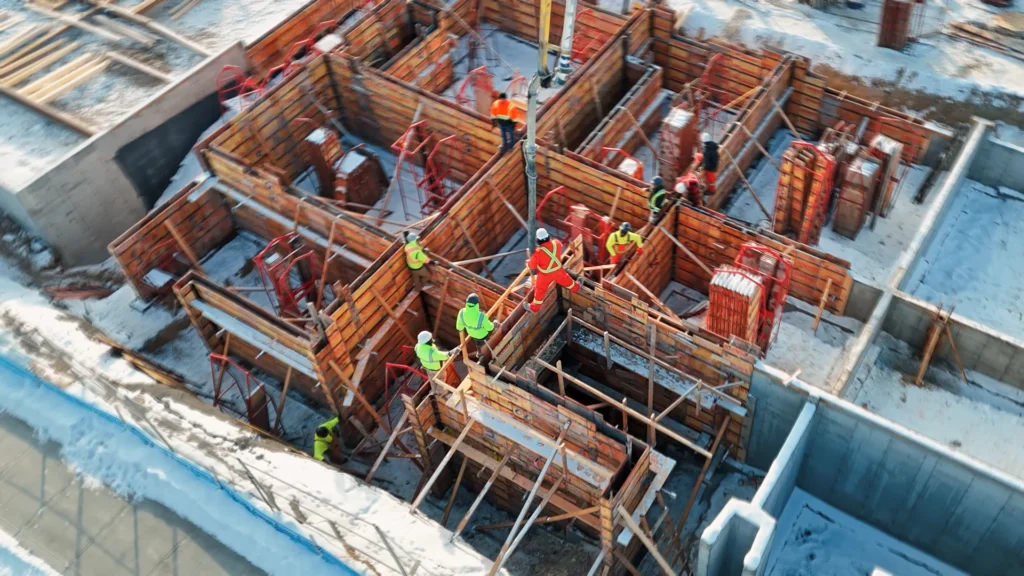
Read that list against what a construction company actually has to offer. Real video — a jobsite walkthrough. Real people — the superintendent and the crew on camera. Real locations — the actual site, the actual pour, the actual building going up. A construction company is sitting on the exact form of proof the trust crisis has made most valuable, and most contractors are leaving it uncaptured.
This is the inversion that should reframe how an owner thinks about the cost of a shoot. In a web full of fakeable content, the unfadeable becomes the premium. Anyone can generate a slick “construction excellence” video with stock footage and an AI voiceover — and increasingly, both buyers and engines discount exactly that. What cannot be faked is the named superintendent, on the real site, in the real conditions, describing the real work in his own words. That is the signal that clears. As Construction Business Owner puts it, video builds trust faster than static images because the buyer “can see craftsmanship, team interactions and real project conditions.” You cannot synthesize a real jobsite. You can only capture one.
So the trust crisis cuts directly in favor of the construction owner who shows up on camera, and directly against the one who hides behind a stock-photo website. The machine is increasingly built to weight what can’t be faked — and a contractor’s reality is the hardest thing on the internet to fake.
Why Contractors Lose Bids: The Bid Room Filter
Step back and look at the two judgments side by side, because they are not analogous — they are identical, run by different judges at different moments in the same buying journey.
| The procurement officer | The AI engine | |
|---|---|---|
| The question | “Can I trust this contractor to do the job and defend the choice to my boss?” | “Which contractors can I confidently recommend for this query?” |
| What it looks for | Track record, crew proof, safety culture, evidence the company is real | Multi-source consensus across reviews, directories, forums, video, local media |
| What “thin” looks like | A clean price with no proof behind it | A website + GBP and not enough data points |
| The verdict on thin | Ranked last; quietly screened out | Left out of the answer; not surfaced |
| What clears it | Demonstrated qualifications (the ~12% win edge) | Verifiable third-party signals — real video, real people, real locations |
The PM and the engine are asking the same question — is this real and can I trust it — and screening out the same failure mode: insufficient proof. The only difference is sequence. The machine runs its filter first, when your buyer opens ChatGPT to build a shortlist. The human runs it second, if you survived the machine. A thin contractor now fails twice, and the first failure is invisible — you never find out the AI left you off the list, you just notice the bids stopped coming.
This is why the fix is not two separate projects. The footage that proves you in the bid room — the jobsite walkthrough, the owner on camera, the project case study, the crew at work — is the same footage that gives the machine its multi-source data points. One shoot solves both filters, because both filters are looking for the same thing: proof that you are a real, capable, trustworthy company, shown rather than asserted.
6. The Communication-First Method: Proof Has to Be Shown, Not Claimed
Here is where most attempts to fix the proof gap go wrong, and where Storimatic’s Communication-First Method does the heavy lifting.
The instinct, when a contractor finally accepts he has a proof problem, is to claim harder. Add more adjectives to the website. “Industry-leading.” “Trusted since 1998.” “Committed to excellence.” None of it works, for the same reason in both the bid room and the machine: a claim about yourself is the weakest evidence there is. The PM discounts it because every bidder says it. The AI discounts it because it’s on your own website, which it weights at a third of a third-party source. Asserted proof is not proof. It’s noise.
The Communication-First Method inverts this. The principle is that the message — the proof, the trust, the substance — comes first, and the production serves it. You don’t decorate a thin company with better adjectives. You capture the actual substance that makes the company trustworthy and let it speak for itself:
- Instead of “we have a great safety culture” on the website, you capture the superintendent walking through the actual pre-task hazard assessment on a real site, in his own words. The buyer sees the safety culture. The machine reads it in the transcript.
- Instead of “experienced crew,” you capture the crew doing the difficult thing — the complex pour, the tight-tolerance install — with the foreman explaining the call he made. Demonstrated, not declared.
- Instead of “trusted by clients,” you capture the client saying why, on camera, named, on a third-party platform. The strongest possible form of the 3x-weighted third-party signal.
This is communication-first because the communication — the real, shown, substantive proof — is the product, and the camera is in service of capturing it accurately. It’s the opposite of the stock-footage brand video that asserts everything and proves nothing. And it’s the only approach that produces an asset which clears both filters, because both filters reward shown proof and discount claimed proof.
The construction owner’s discomfort here is real and worth naming: most owners would rather hide behind a polished website than stand on a site and talk to a camera. But the website is the thin signal. The owner on the site, talking straight, is the signal that clears. The Communication-First Method is built to get a camera-shy operator to that captured, unfakeable proof without turning him into a performer — which is the subject of how we actually run these shoots, and a thing no generic videographer knows how to do.
7. Recruiting: The Same Footage Solves the Second Bleeding Wound
There is a second cost to being a thin company, and it doubles the return on fixing the proof gap — especially in Alberta right now.
Apprenticeship registrations have hit a decade low, and every $5–50M owner is bleeding margin on recruiter fees to fill crews. When a red-seal apprentice or an experienced journeyman is deciding where to work, they do exactly what buyers do: they ask. They Google. Increasingly, they ask AI — “what’s it like to work at [company]” — and they look for proof of the culture before they apply.
A thin company fails that filter too. There’s nothing to find. No crew on camera, no glimpse of the actual sites and the actual work, no evidence of how the company treats its people. The recruit reads the same thing the PM and the machine read: thin, possibly a shell, not enough to trust. And they take the offer from the company whose culture they could actually see.
The fix is the same shoot. Crew-culture video — team interviews, jobsite highlights, the foreman talking about how the company runs a site, the safety practices shown rather than claimed — is simultaneously:
- The proof signal that wins the bid (Section 1’s 12% qualification edge)
- The multi-source data the AI needs to recommend you (Section 2)
- The recruiting asset that answers the apprentice’s “what’s it like to work there”
Two ROIs — won bids and filled crews — from one capture, in a province where both wounds are bleeding at once. The owner who’s been treating “marketing video” and “recruiting” as separate line items, or as luxuries he can’t justify, is missing that one shoot day services both, plus the AI-visibility problem he didn’t know he had.
8. This Isn’t Construction-Only — Every Thin Vendor Reads as a Shell
The mechanism is sharpest in construction because procurement is so explicitly a trust-and-proof exercise. But the shell-company filter runs across every vertical Storimatic serves, because multi-source consensus is how AI evaluates everyone.
Corporate B2B: When a buyer asks AI to recommend a vendor in your category, the company with executive interviews, customer-story films, and a founder who appears on camera reads as a real, recognized entity the machine can corroborate. The company with a stock-footage homepage reel and nothing else reads as thin — and gets left off the shortlist before the buyer ever visits the site.
Nonprofit and education: When a program officer or major donor asks AI which organizations are doing credible work in a cause area, the nonprofit with documented impact films and beneficiary stories has multi-source proof of real outcomes. The one with a logo and a mission statement has an assertion the machine can’t corroborate — and a board that will ask, fairly, why the organization didn’t surface.
Events: When someone asks AI what an event is actually like, the organizer with documented footage from prior years has the proof; the one with a save-the-date graphic has a claim.
Across all of them, the rule from the flagship reframe holds: AI needs multi-source consensus, and video is the densest way to manufacture it. Thin reads as a shell — to the machine — no matter what you sell. The construction bid room just makes the stakes most visible, because there the human runs the same filter, out loud, with a contract attached.
9. The 5 Counter-Intuitive Truths
- Silence is a negative signal, not a neutral one. Having no video doesn’t leave you at zero — it actively starves the AI of the multi-source data it needs to trust you, which reads as a reason to pass. The absence is the problem.
- Your own website is the least trusted source about you. AI weighs third-party mentions ~3x higher than your homepage. Polishing the one source you control is the weakest move available. Manufacture the other sources.
- Bid loss is a proof problem, not a price problem. The owner shaving his margin to bid lower is solving the wrong problem and losing anyway. Experienced contractors win ~12% more on demonstrated qualifications.
- The AI runs the procurement filter first, and invisibly. You never find out the machine left you off the shortlist — the bids just stop coming. The human only judges you if you survived the machine.
- The trust crisis favors the contractor who shows up on camera. As fakeable content floods the web, the unfakeable — real superintendent, real site, real work — becomes the premium signal. A construction company owns the hardest thing on the internet to fake.
10. FAQ
Why would AI treat my company as untrustworthy just because I don’t have video?
Because AI builds recommendations from multi-source consensus — it cross-references review sites, directories, forums, video, and local media looking for agreement about you. A contractor present only on a website and Google Business Profile gives it “not enough data points to trust them” (Geek Powered Studios, 2026). It’s not that the AI judges you negatively on purpose; it has too little independent evidence to recommend you confidently, so it surfaces competitors it can corroborate. The absence of proof reads as a reason to pass.
Isn’t a professional website enough to look legitimate online?
To a human glancing at it, maybe. To an AI engine deciding whom to recommend, no. Your own website is the source the machine trusts least — third-party mentions are weighted roughly 3x higher (Search Engine Land, 2026). A beautiful website with no corroborating third-party signals (video, reviews, project documentation, local media) is exactly the “shell company” profile: one source, talking about itself, with nothing to confirm it.
How is the AI’s judgment connected to losing bids?
They’re the same judgment at two points in the buying journey. 94% of B2B buyers now use AI to build a shortlist before contacting any company (G2 / Forrester, 2026). If you fail the AI’s multi-source-consensus filter, you’re left off the shortlist and the procurement officer never sees your bid. If you survive it, the PM then runs the same test — looking for proof you’re real and capable. Both screen out “thin.” The AI just runs first, and invisibly.
What kind of video actually fixes the shell-company problem?
Verifiable, third-party-distributed proof: a jobsite walkthrough with the actual superintendent, an owner-on-camera explainer, project case-study films, and customer testimonials — published to YouTube and clipped to LinkedIn, not buried on your homepage. The 2026 standard is “real video, real people, real locations” (National Law Review / industry coverage, 2026). Stock footage and AI-voiceover “brand videos” don’t clear the filter — they’re exactly the synthetic content buyers and engines now discount.
I’d rather not be on camera. Do I personally have to appear?
The owner-on-camera signal is the strongest one, but the Communication-First Method is built to get a camera-shy operator there without turning him into a performer — by capturing real substance (walking a real site, explaining a real call) rather than scripting a performance. And even beyond the owner, the multi-source picture is built from the crew, the projects, the clients, and the work itself. The point isn’t polish or charisma. It’s verifiable reality, shown rather than claimed.
Does the video also help with hiring?
Yes — that’s the doubled ROI. Apprenticeship registrations in Alberta hit a decade low, and recruits run the same filter buyers do: they ask AI and search “what’s it like to work at [company].” Crew-culture video answers that question with proof of the culture, while the same footage wins bids and feeds the AI. One shoot day services bid-room proof, AI visibility, and recruiting at once.
How does this connect to the rest of what you do?
Storimatic captures the proof (the jobsite footage, the owner on camera, the testimonials — the multi-source signals). The sister company Biostack makes that proof findable — distributing it onto the third-party surfaces, structuring the transcripts, and tracking whether your name actually comes back when a buyer asks. We cover that hand-off in “Make the Video, Then Make It Findable.” One manufactures the proof; the other makes it the consensus.
11. The Take-Home
There’s a moment every contractor who’s lost a bid he should have won will recognize: the silence afterward. No feedback, no second look, just a “we went another direction.” It almost never means your number was wrong. It usually means you were thin — a clean price with not enough proof behind it to win a decision that was really about risk.
That same thinness now costs you a step earlier, where you can’t even see it. The buyer asks the machine first, and the machine runs the procurement officer’s exact filter: is this company real, can I corroborate it, do I have enough to recommend it. A website and a Google profile and nothing else gives it “not enough data points to trust them.” Multi-source consensus is the algorithm, your own website is the source it trusts least, and the absence of real footage isn’t neutral — it’s the signal that gets you skipped.
The fix is not a better website or louder claims. It’s verifiable proof, shown rather than asserted, distributed onto the third-party surfaces where the machine looks for consensus — real video, real people, real locations. The footage that proves you in the bid room is the same footage that proves you to the machine and the same footage that fills your crews. One shoot, three filters cleared.
A thin company reads as a shell — to the procurement officer and to the AI. The proof you’ve been failing to show is the proof both are looking for.
12. About the Author
Jared Ho is the founder of Storimatic Studio (Calgary video production), the founder of Biostack (AI-visibility / GEO-AEO agency). The bid-room scar in this post is not borrowed. Jared runs real concrete businesses, has sat on the wrong end of a lost bid that wasn’t about price, and watched a five-person Edmonton precast operator — exactly the kind of company a machine would dismiss as thin — go from invisible to Top-3-cited in Alberta AI search by building the proof the algorithm was looking for (Recommendation Rate 0% → 66% over nine months, ~$22K of work that started with a shortlist the company finally appeared on).
Storimatic is the only video studio connecting the shell-company signal in the machine to the proof problem in procurement — because it’s the only one run by an operator who lives in the bid room and runs the AI-visibility agency.
13. Book a Discovery Call
Want to know whether the machine currently reads your company as real — or as a shell? Book a 30-minute discovery call. We’ll run your category’s top buyer questions through ChatGPT, Perplexity, Gemini, and Google AI Mode, show you whether your name comes back and what gets said when it does, and map the single shoot day that would give the machine — and the next procurement officer — the proof both are looking for.
Book a discovery call with Storimatic Studio. We don’t quote a production without that conversation. The website was never the proof. The footage is.
Sources
Primary anchor data:
- Geek Powered Studios — AI Visibility for Contractors 2026 Guide (the “not enough data points” / multi-source consensus finding; “real video, real people, real locations”)
- Search Engine Land — Social and UGC: the trust engines powering search everywhere (third-party mentions weighted ~3x)
- Construction Business Owner — How to Create High-Impact Marketing Videos (video shows craftsmanship, team, real conditions)
Buyer behavior + trust:
- G2 2026 AI Search Insight Report (94% of B2B buyers shortlist via AI; 85% think more highly of AI-cited vendors)
- Forrester — Is AI Visibility Your 2026 Imperative?
Video as third-party signal:
- OtterlyAI — YouTube Citation Study 2026 (YouTube as a top AI citation source; structure over reach)
- Search Engine Land — AI search engines cite Reddit, YouTube, LinkedIn most
GEO/AEO Schema Markup Notes (for publisher)
- Article schema —
author= Jared Ho (Person),publisher= Storimatic Studio,datePublished= “2026-05-20”,mentions= [Geek Powered Studios, Search Engine Land, G2, Forrester, YouTube, ChatGPT, Perplexity, Google AI Mode] - FAQPage schema — wrap Section 10 with FAQPage structured data; each answer is self-contained and front-loaded for extraction
- VideoObject schema — every embedded video (the jobsite walkthrough, the owner-on-camera explainer) gets full VideoObject markup with transcript, chapters/Clip, uploadDate, and a 300+ word description — the proof asset must itself be machine-readable to count toward consensus
- DefinedTerm schema — “multi-source consensus” · “shell-company signal” · “the Communication-First Method” · “proof problem” · “third-party signal” · “verifiable signals”
- Statistic / Claim schema — every quantitative claim (3x third-party weighting, ~12% qualification-win edge, 94% AI-shortlist, 85% vendor perception) with QuantitativeValue + citation attribution
- Speakable schema — TL;DR, the “not enough data points” finding (Section 2), the multi-source-consensus mechanic (Section 3), the bid-room/machine comparison table (Section 5), the take-home (Section 11)
- Internal linking — link to the 92 Rules (#44, #48, #53), the Communication-First Method / AOD, S-1, S-2, and the X-2 cross-brand flywheel
Cross-platform distribution plan (eat our own dog food):
- storimatic.ca/blog — primary publish with full schema; embed a chaptered, transcribed jobsite-walkthrough demonstrating verifiable proof so the post about the shell-company signal is itself an anti-shell artifact
- YouTube long-form — 12-min “No crew footage reads as a shell company” with Jared on camera at a real Omega site, chaptered at: bid loss is a proof problem / the shell-company signal / multi-source consensus / the trust crisis / the bid room and the machine / recruiting double-ROI — human-reviewed transcript, 334+ word description
- YouTube chapters as citation surfaces — each chapter named for the buyer/procurement question it answers, so the video is cited across multiple chapters
- LinkedIn (Jared’s personal profile) — native long-form article + 4 clips cut from the long-form (the “thin = shell” reframe, the 3x third-party stat, the proof-not-price line, the recruiting double-ROI)
- Reddit — answer-seed for r/Construction, r/ConstructionManagers, r/smallbusiness: “why your contractor business is invisible to ChatGPT” with the multi-source-consensus explanation
- Email — the Section 11 take-home as a standalone send to the construction list, subject line on the “thin bidder” scene
Quarterly refresh:
- Q3 2026: re-verify the Geek Powered “multi-source consensus” framing and pull any updated contractor-AI-visibility data
- Q4 2026: add a verified Storimatic construction client result — a contractor who appeared on an AI shortlist (and won a bid) after building real proof footage
- Q1 2027: re-check the third-party-weighting multiple and buyer-adoption figures (fastest-moving), and confirm the trust-crisis “real video, real people, real locations” standard still holds as provenance tooling (C2PA) matures
Related Articles
- Why AI Cites YouTube Before Recommending Your Company
- AI Reads the Transcript, Not the Views
- Video Marketing for Construction Companies: The Communication-First Method
- 12 Proven Tips For Choosing The Best Construction Video Company

Written by
Jared Ho
Founder of Storimatic Studio in Calgary. Video production specialist for businesses, with a focus on the construction industry, delivering 750+ projects and 20M+ views for clients. Services include construction video production, corporate video, training video, brand storytelling, and aerial drone footage. Drone-licensed and on-site at every shoot.
Ready to turn this into a video that wins business?
View Storimatic Video Services →